Tag: worldbuilding

  • Free Fantasy Worldbuilding Guide for Kids (Ages 8–12)

    Free Fantasy Worldbuilding Guide for Kids (Ages 8–12)

    Have you ever watched a child build an entire kingdom out of LEGO bricks? Or draw a treasure map of an imaginary island with fantastical monsters?

    I have. I was that kid, and I’ve taught those kids. Imagination and possibility hide around every corner of a child’s mind—they just need a little encouragement to bring those ideas to life.

    Kids are Natural Worldbuilders

    Before a child ever learns words like “setting” or “worldbuilding,” they’re already imagining underwater cities, hidden forests, talking animals, underground tunnels, and magical kingdoms.

    Play Barbies with a group of five-year-olds for twenty minutes, and soon you have a nice mermaid, an evil queen, and someone using her freeze powers (when did she get those) to stop the bad guys.

    Tell a group of seven-year-olds that their play equipment is a grand sailing ship, and watch as they invent sea monsters, a shocking number of tsunamis (not sure how we survived so many), and a wicked octopus.

    Hand a group of eight- to ten-year-olds some aged paper, a list of questions, and the freedom to create whatever they want—and voilà! Worlds will be born. I did this with my students a few years ago, and their creativity absolutely delighted me.
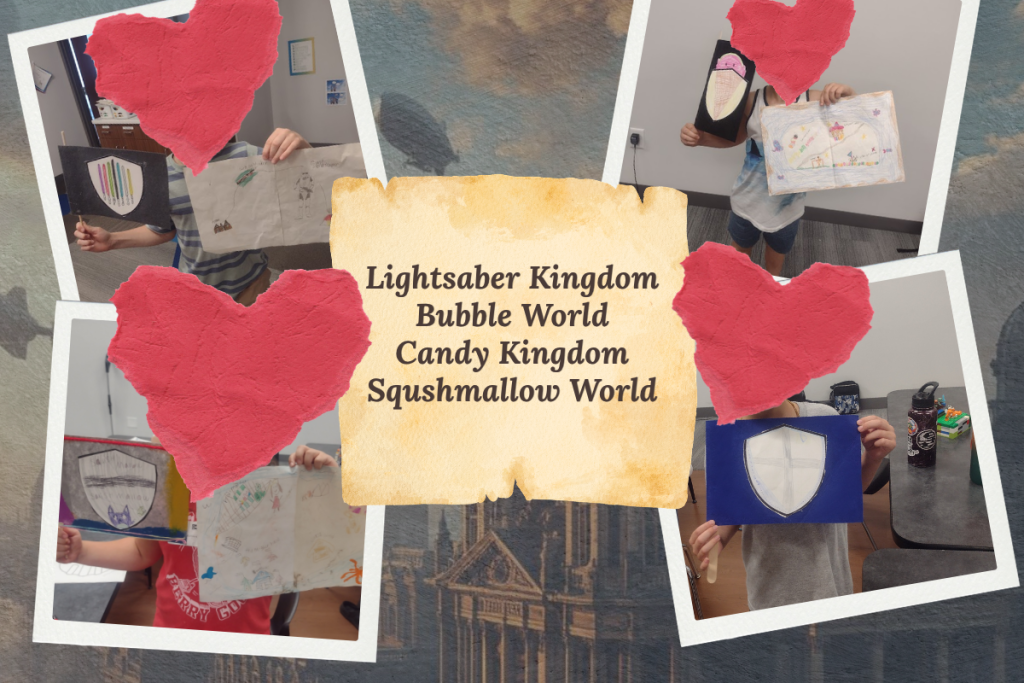
    Elementary students holding fantasy maps and worldbuilding projects they created during a creative classroom writing activity.
    Students proudly display the fantasy worlds they created during a classroom worldbuilding activity.

    After experiencing the joy of worldbuilding with kids, I decided to create the Young Worldbuilder’s Starter Kit—a free printable activity guide inspired by the world of Willomina Tip: Lost in the Imperial City.

    Whether your child dreams of writing stories, loves fantasy adventures, or simply enjoys drawing maps and inventing new places, this guide is designed to help turn imagination into something they can build, explore, and eventually write about.

    What’s Inside the Young Worldbuilder’s Starter Kit?

    The printable workbook is packed with creative activities that encourage kids to think like authors and explorers.

    Inside, they’ll find:

    • A welcome from Willomina herself
    • A fantasy world questionnaire to spark ideas
    • A guided map-building activity
    • Character creation worksheets
    • A character drawing page
    • A fantasy vehicle design activity inspired by the airships of the Imperial City
    • A personal letter from Willomina encouraging young creators
    • A creative writing adventure page
    • An Official Young Worldbuilder Certificate. (Like, very official; some might call it “frameable.”

    Every activity is designed to encourage creativity without feeling like homework.
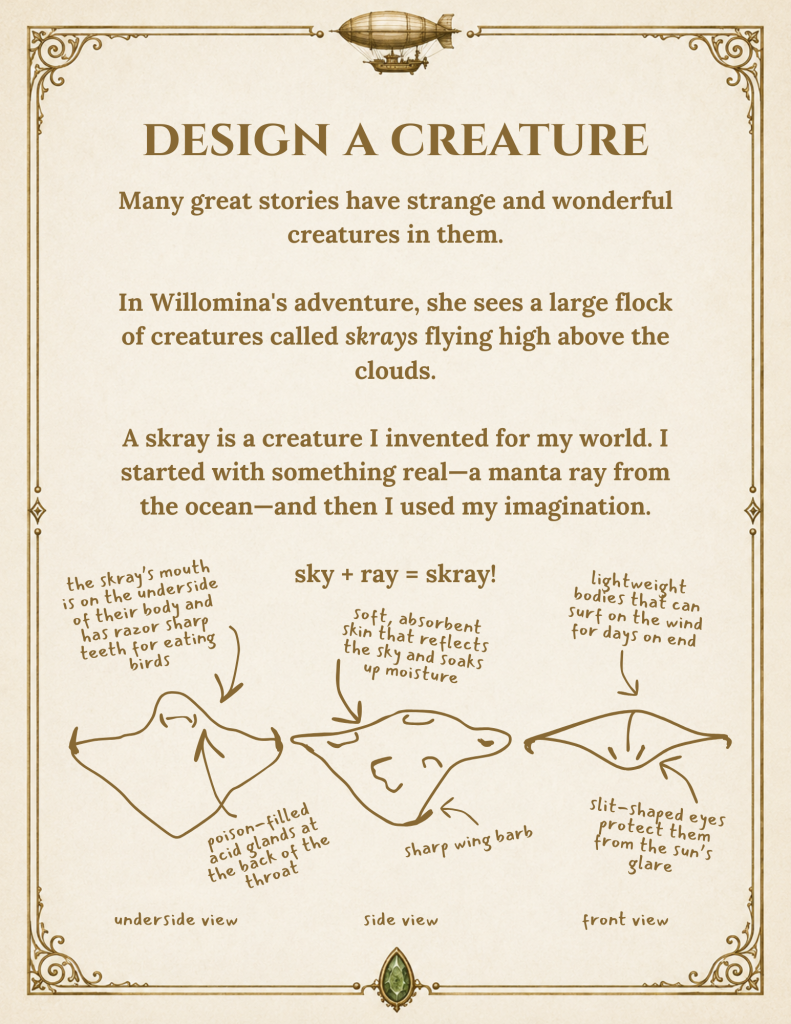
    Printable creature design worksheet where children imagine and illustrate an original fantasy creature with unique traits and abilities.

    More Than a Writing Worksheet

    I’ve always learned best by creating something. As a kid, that meant drawing characters and inventing stories. As an adult, I discovered my students learned the same way.

    Think about it, worldbuilding naturally combines:

    • Creative writing
    • Reading comprehension
    • Art
    • Critical thinking
    • Problem solving
    • Imagination

    Instead of filling in blanks with “correct” answers, children become the author, cartographer, inventor, and explorer of their own world.

    Kids are always being told how the world works, what can or cannot happen, and what to do. But when they become the worldbuilders, suddenly they are in charge, and there isn’t just one right answer. It’s whatever they can imagine.
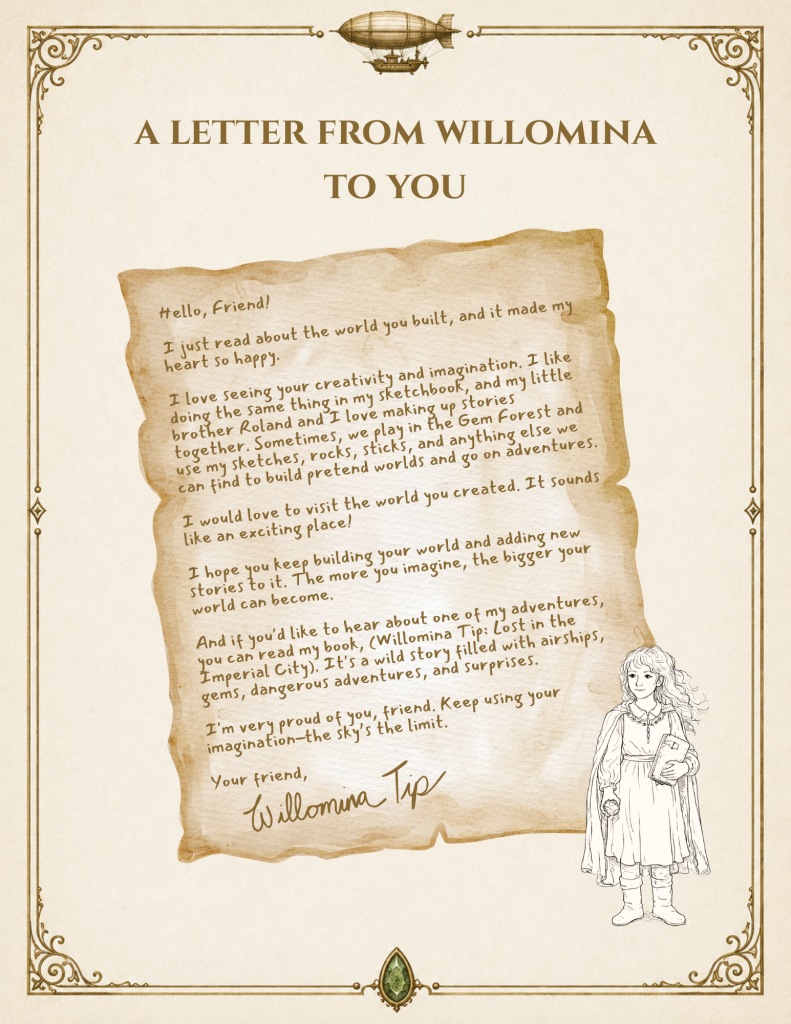
    Letter from Willomina Tip welcoming young readers and encouraging them to become confident worldbuilders and storytellers.

    Inspired by Willomina Tip

    Many of the activities draw inspiration from the world of Willomina Tip: Lost in the Imperial City, a whimsical world of floating islands, airships, mysterious legends, and dangerous revolutions.

    But the point of this workbook is not to copy my world.

    My goal is to give young creators the tools and confidence to build one of their own.

    Download Your Free Copy

    If your child loves fantasy, storytelling, drawing maps, or imagining entirely new worlds, I’d love to share this free resource with you.

    Join the Polaris Network newsletter below, and I’ll send the Young Worldbuilder’s Starter Kit straight to your inbox. (You have my solemn promise that I will never spam you.)

    I hope it inspires many new adventures—and maybe even the first chapter of a story only your young author can tell.

    Author Grace Gidman smiling in a warm, natural headshot wearing an orange blouse against a soft neutral background

    About Grace Gidman

    Grace Gidman is the author of Willomina Tip: Lost in the Imperial City and a former elementary educator who loves encouraging children to read, imagine, and create. Through stories, printable activities, and fantasy resources, she hopes to inspire the next generation of young worldbuilders and storytellers.
  • Why Rats Became Heroes Instead of Villains in My Fantasy World

    Why Rats Became Heroes Instead of Villains in My Fantasy World

    Let’s be real, people: rats conjure up some pretty scary images.

    • Bubonic plague.
    • The villainous rat in The Lady and the Tramp
    • Professor Ratigan (The Great Mouse Detective)
    • Any filthy, dangerous, unsavory part of town always = rats

    Even Templeton the rat in Charlotte’s Web was grouchy and had to be bribed into bringing back written materials to inspire Charlotte’s pig-saving efforts.

    Rats have earned a reputation in stories and popular culture as villains, tricksters, or creatures to avoid.

    But I’ve spent years learning about rats, and the truth is they deserve a much better reputation. These tiny, feared creatures are actually incredible once you get to know them.

    When I was creating the world of Willomina Tip: Lost in the Imperial City, I needed an animal that was intelligent, adaptable, and believable in a sprawling fantasy city. What could be more perfect for that environment than rats?

    Let’s dive into these marvelous little creatures!

    Rats Are Incredibly Intelligent

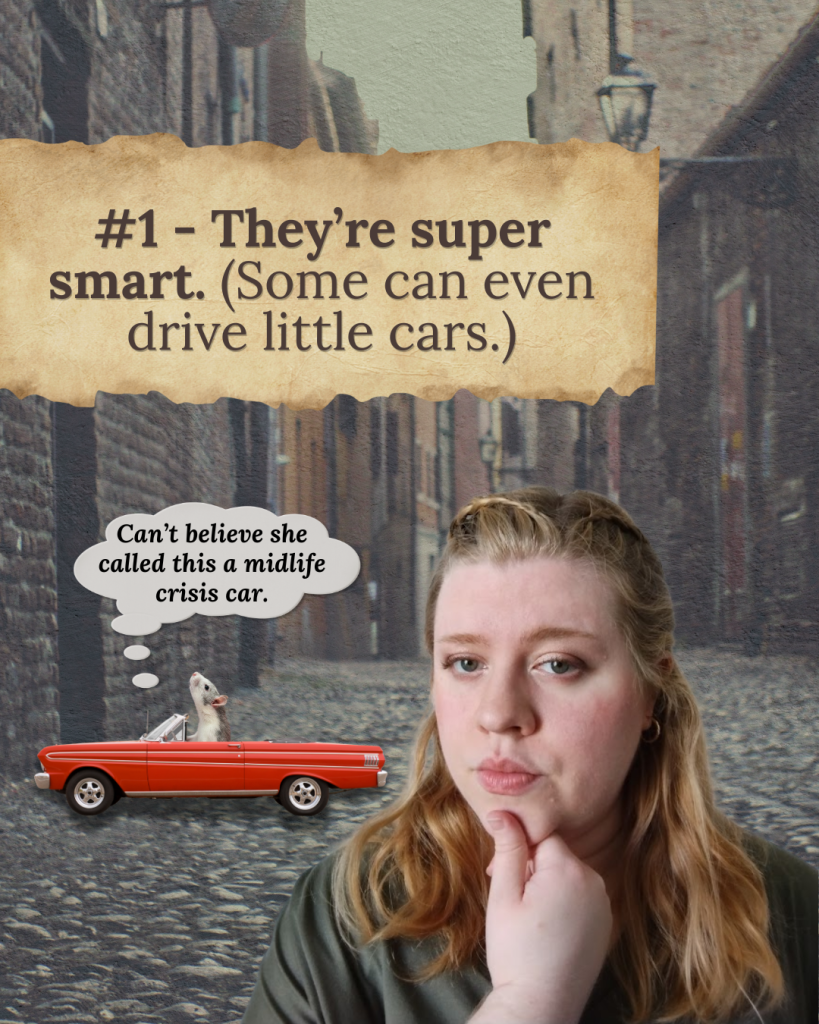
    Illustration explaining that rats are highly intelligent animals capable of solving puzzles, remembering solutions, and even learning to drive tiny cars.

    Rats are among the smartest animals in the world.

    They can solve puzzles, learn complicated tasks, remember solutions for long periods of time, and even navigate mazes with remarkable speed. Researchers have even taught rats to drive tiny cars, proving just how adaptable and curious they can be.

    That intelligence made them a natural fit for my story. I wanted readers to enjoy an animal sidekick that exemplified a “Disneyfied” level of intelligence, but was actually all based on reality. Rats really are that smart!

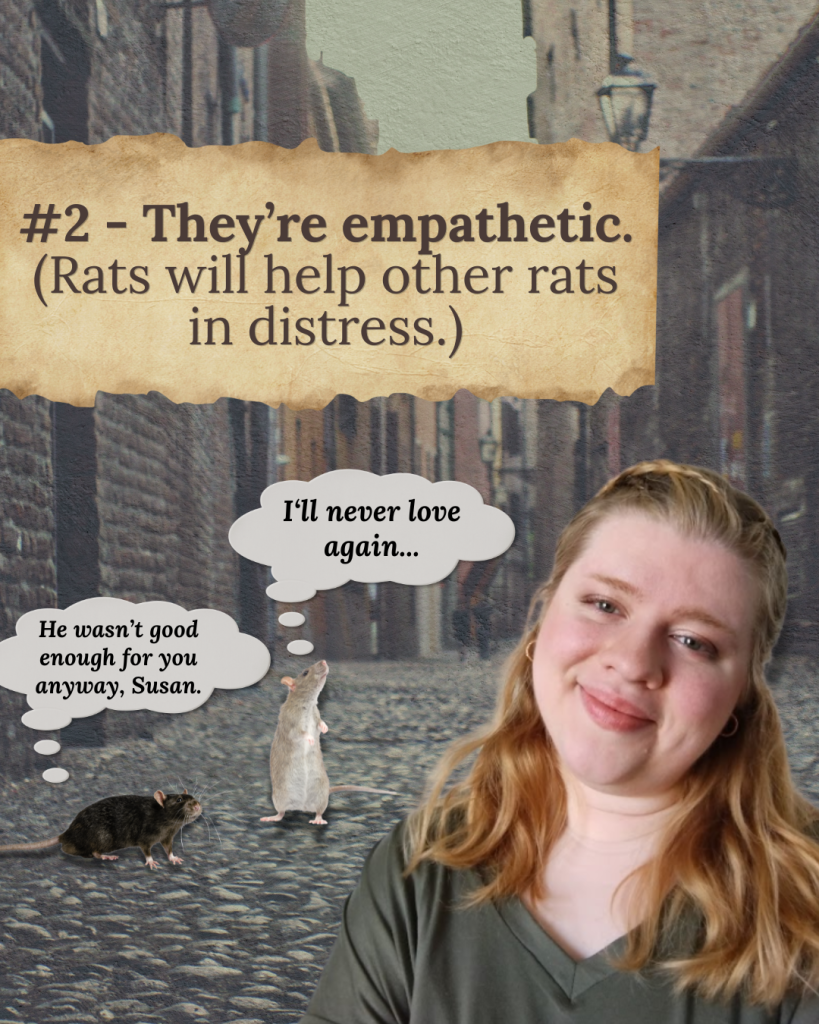
    Rats Show Empathy

    Graphic explaining that rats help other rats in need and display empathy without expecting rewards.

    One of my favorite discoveries was learning that rats genuinely care about one another.

    Studies have shown that rats will help trapped companions—even when there is no reward waiting for them. They’ve even been observed sharing food with other rats in need. (We’re not talking boring food; we are talking CHOCOLATE CHIPS, PEOPLE! That is true love.)

    That’s a far cry from the selfish, greedy image many people have of them.

    The rats in my story show deep empathy, anticipate positive and negative emotions, and respond to other characters’ needs without thought for their own safety.

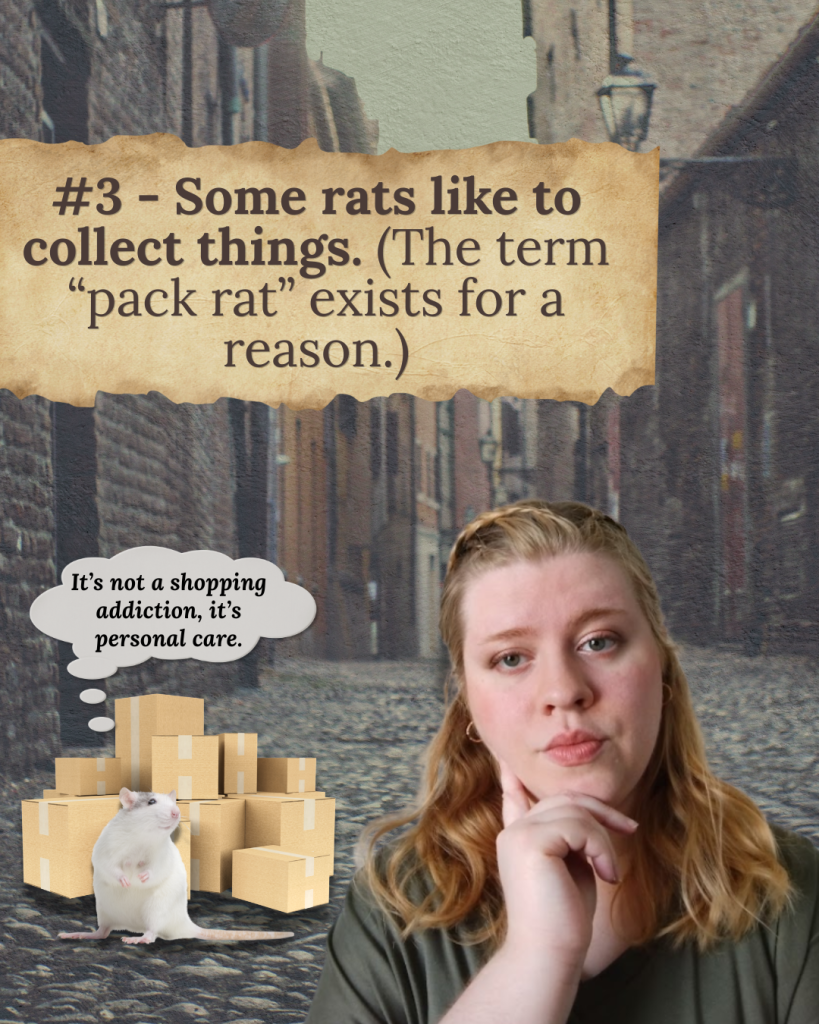
    Rats Love Collecting Treasures

    Illustration showing that rats naturally collect food and interesting objects for their nests.

    Real rats are natural collectors.

    Whether it’s food or interesting little objects, they’ll often carry things back to their nests and build hidden collections.

    As a little girl, I actually had a concern that a rat might show up one day and drag my favorite stuffed bunny away, and I would never see her again.

    Now as an adult, I see the likelihood of that happening was minimal. But as a fantasy writer, that’s incredibly fun to imagine, as well as useful to the plot. I even worked this collecting habit into the Imperial legend of “Abbot the Rat-catcher“, where it became an important part of the story.

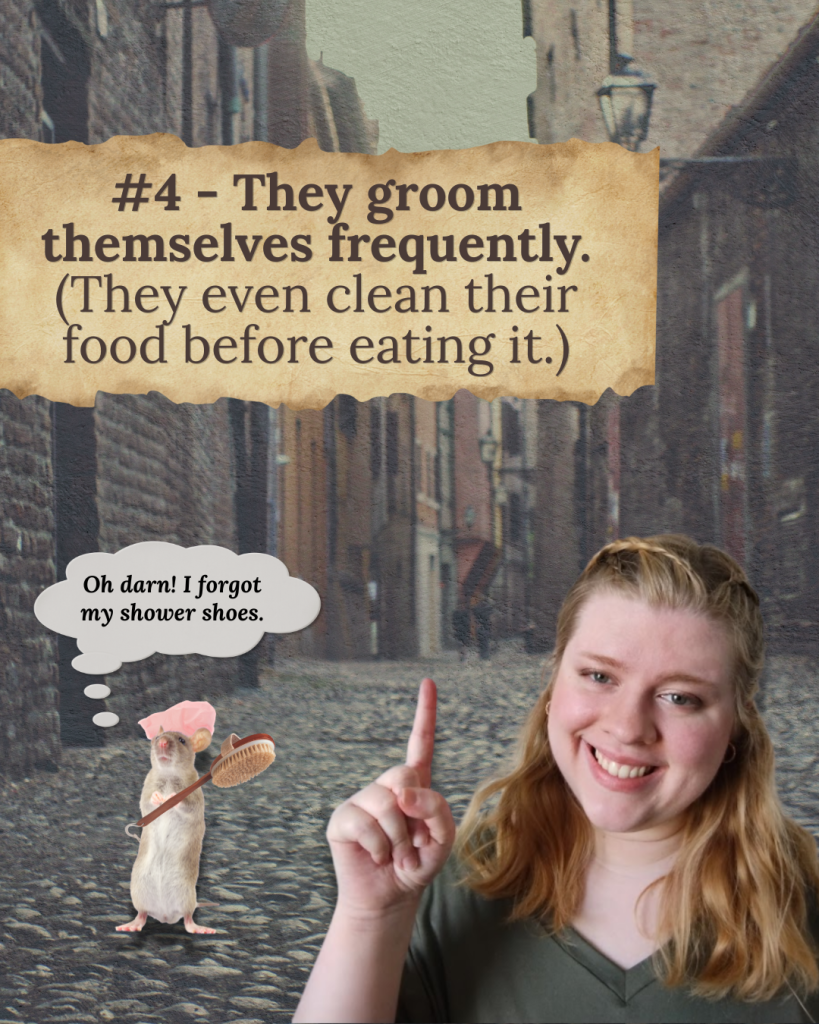
    Rats Are Dedicated Groomers

    Illustration explaining that rats spend much of their day grooming themselves, each other, and even cleaning their food.

    Despite what many people assume based on their living environments, rats are remarkably clean animals.

    They spend an astonishing 20–30% of their day grooming themselves and other members of their group. They even clean their food before eating it.

    The rats in Willomina Tip have to scurry and crawl through the dark and sometimes unsavory corners of the Imperial City, but they frequently stop to clean themselves before moving on to the next scene.

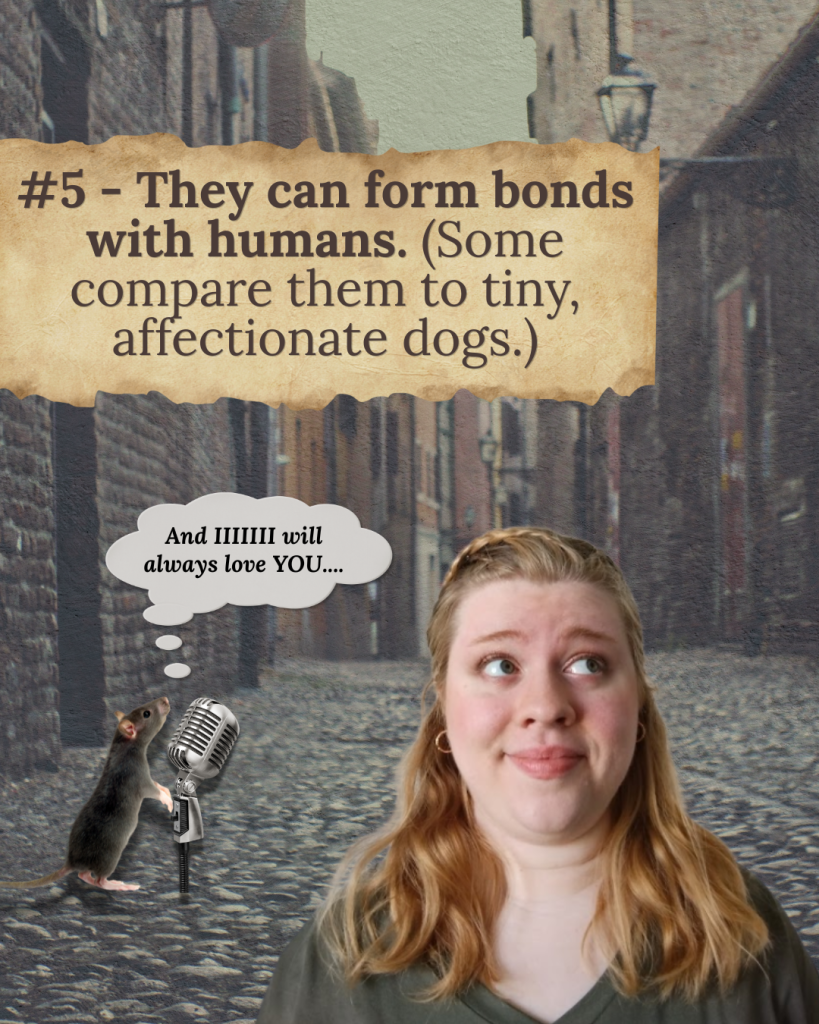
    Rats Can Form Strong Bonds with Humans

    Illustration showing that rats recognize favorite people, enjoy affection, and form strong bonds with humans.

    Pet rat owners have known this for years.

    Rats recognize their favorite people, remember experiences for long periods of time, enjoy playing, and often seek out affection from the humans they trust.

    They’re curious, social, and surprisingly affectionate animals.

    I majorly played into this side of my rats’ natures. My rat characters are deeply affectionate, loyal, and quick to respond to their friends’ needs. (And they really do save the day multiple times.)

    How Rats Inspired Willomina Tip

    I’ve spent years reading about how intelligently and wonderfully God designed rats; they are almost fantasy creatures with “magical” abilities in their own right. I knew this series was the perfect opportunity to give these remarkable little creatures a chance to shine.

    Instead of creating another fantasy story where rats exist only to frighten the heroes, I wanted readers to meet characters who were clever, resourceful, loyal, and unforgettable.

    Judging by the responses I’ve received from readers, that decision has paid off. My little rat friends have become some of the most memorable characters in the book.

    While I enjoyed all of the side characters, my favorite of the new friends that Willomina made was Lady Rose, who is precious and needs to be protected. You’re just going to have to read the book to find out who she is. 😉

    E.F.B., Willomina Tip reviewer

    Meet the Rats of Willomina Tip

    If you’re ready to discover a fantasy adventure filled with floating cities, hidden tunnels, mysterious treasures, and some unforgettable rat companions, I’d love to introduce you to the world of Willomina Tip: Lost in the Imperial City.

    Book cover of Willomina Tip: Lost in the Imperial City featuring the memorable rat companions from the fantasy adventure.

    You just might find yourself rooting for a rat before the story is over.